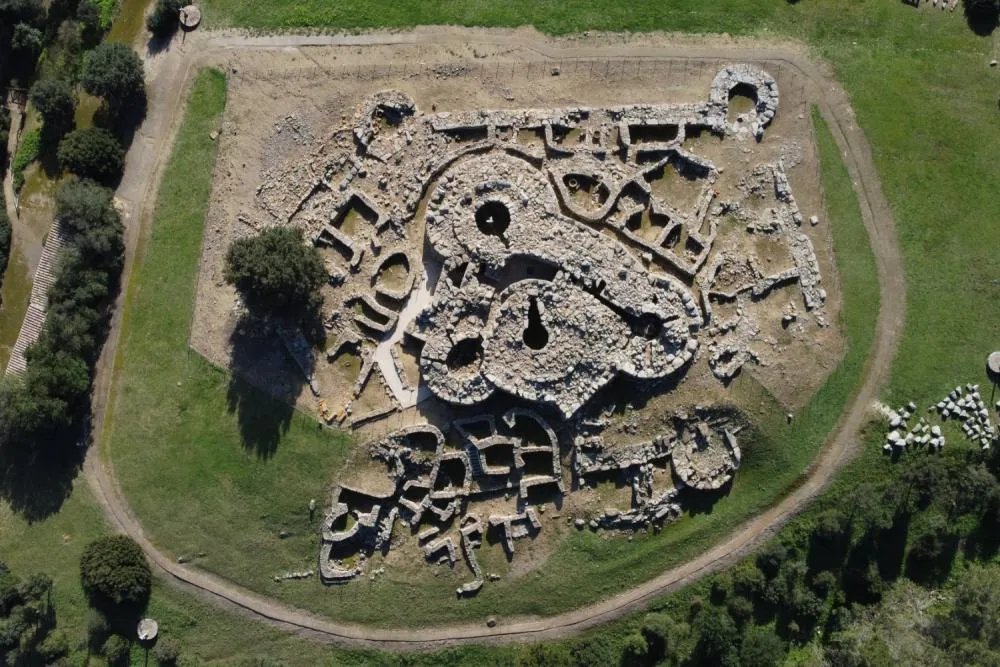

Excavations, which began in 1969, have brought to light an important settlement consisting of a complex nuraghe, a protective bastion, and a village. Nuraghi are structures unique to Sardinia that were built in their thousands on the island during the Bronze Age using large blocks of stone, more or less shaped, and then stacked on top of each other. There are single Nuraghi, consisting of a single tower, and complex Nuraghi, consisting of several towers. Their purpose is still unclear, but considering their location, often on high ground (although there are also Nuraghi in the plains), they are thought to have been civil and religious landmarks for the communities living in the surrounding area, as well as serving to control farmed fields and grazing livestock.
In all likelihood the building served as a centre where goods could be protected and stored. In the Middle Bronze Age, between 1750 and 1450 BC, a small community settled on the hill of Genna Maria, building a nuraghe out of marl, the local stone. It is made up of a central tower, three side towers, and a large enclosure bordered by five towers.
During the Late Bronze Age, between 1450 and 1200 BC, perhaps due to structural collapse, much of the building was reinforced externally with a thick layer of masonry. This cladding led to the creation of a double entrance and the deployment of a lintel made of basalt, a volcanic rock that is much stronger than the local stone. At the end of the Bronze Age, between 1200 and 1000 BC, the nuraghe fell into disuse and in the early Iron Age, around the year 1000, a village was built on the site, made up of small dwellings and communal spaces. At the end of the 9th century BC, for reasons that are still unknown, the village was suddenly abandoned, leaving behind all the objects and everyday tools that had been used up to that point. After its abandonment, the site remained virtually deserted for several centuries, until it was reused in the Punic era as a place of worship. The nuraghe was then repopulated for brief periods up until the Byzantine period, but the collapse of the walls and the accumulation of earth had already begun to bury the entire building until it was brought back to light by the archaeologists.