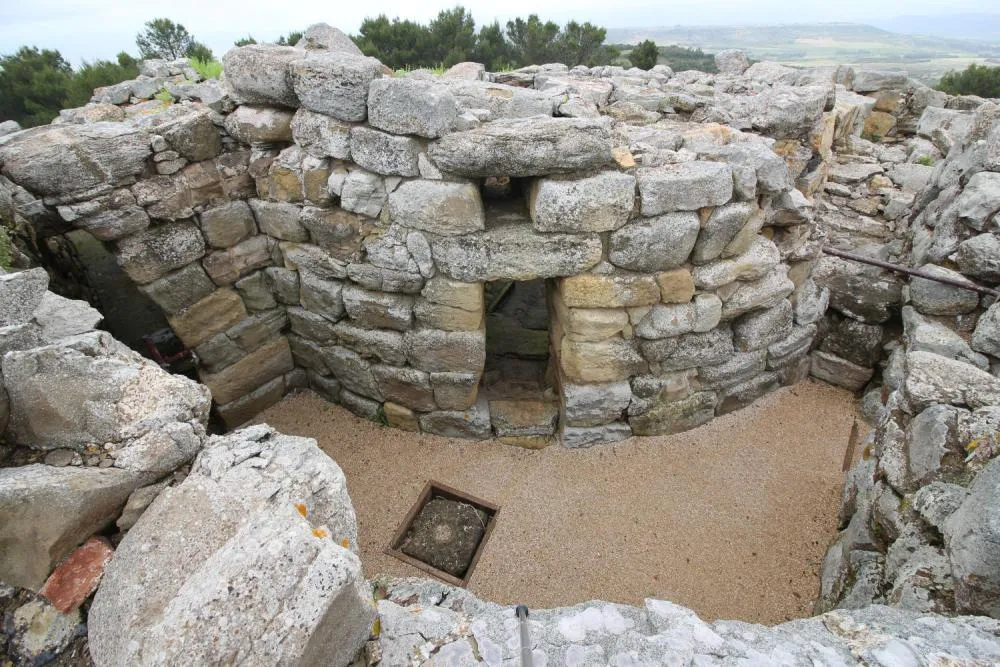

Most nuraghe have domed chambers one on top of the other connected by spiral staircases built into the walls. Some of them could have as many as three chambers and reach a height of about 25 meters. The towers of the Genna Maria nuraghe, perhaps due to the poor quality of the marl, which led to repeated fracturing, have just the one chamber and must have been between 5 and 6 meters high. Due to collapses that took place in ancient times, the roofs of the towers have not been preserved.
The interior space of the central tower is very cramped, the walls are made of irregular blocks of marl with small volcanic stone wedges filling the spaces between one block and the next. Air and light could only enter the space through the entrance. Structural problems in this part of the entrance, visible from the inside, meant that a supporting pillar had to be added on the right; on the outside, however, it was decided that the front façade had to be completely rebuilt, with the addition of a small window above the lintel so that not all the weight of the walls above rested on it. Very few fragments from the Nuragic period were found inside the nuraghe because, beginning in the 4th century BC, the monument was reused as a sanctuary dedicated to a deity of the agricultural cycle, possibly Demeter, the patron of farmers. From the end of the 6th century BC, the Carthaginian occupation of Sardinia led to the introduction of Punic cults to the island; once the Romans took over the island, the cult of Demeter was replaced by that of Ceres. The archaeological finds discovered inside the tower and in the courtyard bear witness to the centuries-old use of the nuraghe as a place of worship: 650 votive oil lamps, over 250 bronze coins, fragments of glass ointment jars and perfume bottles, silver artifacts, and even a small gold mask all point to the use of the central tower as a space for the deposition of votive artifacts. In the courtyard, however, traces of stone alteration due to continuous exposure to fire and the remains of charred animal bones testify to the use of this area for rituals and cruel sacrifices.